
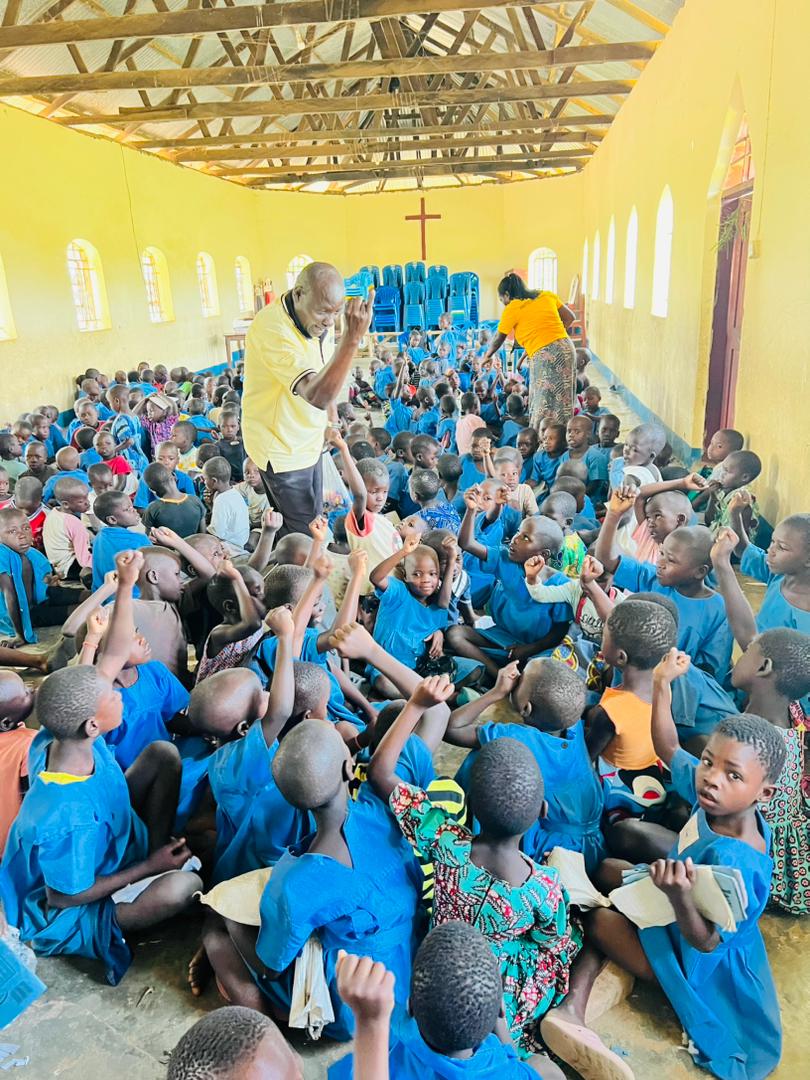
In a small church being used as a classroom for Lwamboga Primary School in Butaleja District, Uganda, Teacher John stands before more than 250 learners seated on the bare floor. There are no desks. The room is rarely quiet.
In a room this crowded and this loud, a child can disappear as easily as a whisper in a crowd. A smaller voice drowned out. A confused face lost somewhere near the back wall. A learner who simply stops trying because nobody noticed.
But that is not what happens in Teacher John’s classroom.
What is most striking is not simply the scale of the challenge, but the deliberate and creative system Teacher John has developed to help every learner participate. This is what deliberate teaching can look like in an exceptionally large class.
The scale of the task is immediately visible. With 250 learners filling every inch of the room, Teacher John has to project his voice to the front, then carry it all the way to the back repeating, checking, and adjusting. Even distributing exercise books is a deliberate act: books are stored in his corner at the back of the classroom, organised into three groups that mirror his learner groupings. When it is time for individual practice, he issues them in sequence Group A first, then Group B and Group C last so that by the time the more independent learners are already working independently, he is free to give Group C his full attention. Every small moment in this classroom demands a system.
Setting the Stage: How the Lesson Begins
Teacher John follows the clear lesson structure set out in the NRD programme materials. Building Tomorrow is implementing the programme with Primary 1 learners in public primary schools across Butaleja District. He begins with a familiar clapping rhythm that helps learners focus from the first minute. In a room this large and this loud, this opening ritual does more than settle the learners down. It signals to every child, from the front row to the back wall, that the lesson has begun.
From there, Teacher John teaches the whole class together. Every learner receives the same initial explanation, demonstration and examples. But underneath this shared start lies a deliberate philosophy: Teacher John does not teach to where the curriculum expects his learners to be. He teaches from where they actually are. This shapes everything that follows.
He is also creative with materials. Using bottle caps, seeds, stones, and sticks, objects learners already know from their own homes and shops, he makes numbers tangible and familiar. He keeps a supply in the classroom and encourages learners to bring their own, so that every group always has something to count with, whatever form it takes.
Guided Practice: Moving Through the Groups
Once the whole-class introduction is done, Teacher John makes his first key decision: he intentionally organises learners into mixed groups, deliberately pairing stronger learners with those who need more support. This is not accidental. It is the same philosophy from the opening, now made structural: every group is composed so that no learner has to struggle alone.
After explaining the guided practice task, he moves from group to group, kneeling beside each cluster, listening for the small voice that gets it right and the smaller voice that stays quiet. Within each group, something important happens. The stronger learners, having just heard Teacher John’s explanation, begin to relay it to their peers in their own words. They share materials, point out mistakes, and nudge a hesitant classmate toward the right answer. Teacher John does not leave this to chance. Before moving into group work, he sets a clear expectation with his learners: if you understand, help the person next to you. Combined with the way he has deliberately composed each group, this priming means that by the time he steps away, the peer support is already in motion. He has not just designed the groups, he has prepared the learners inside them.
In Teacher John’s classroom, understanding spreads the way light does, one flame lighting the next. His job becomes one of moving, listening, and stepping in only where the group cannot resolve things on its own.
This is how one teacher’s voice reaches 250 learners.
Individual Practice: Differentiating Support
Individual practice in Teacher John’s classroom runs on a clear three-group system. He begins with Group A, whose learners can complete more of the written task independently. He issues their books, briefly repeats the instruction, works through the first question together as an example, and sets them off. He then supports Group B with additional explanation or prompting before they begin working independently.
With Groups A and B writing independently, Teacher John turns his full attention to Group C, his pre-writers. Rather than assigning a written task that does not yet match their learning needs, he gathers them for short, active oral practice: counting aloud, pointing to numbers on the flip chart, tracing numbers on the floor and then in their books. This is not a lesser version of the lesson; it is differentiated to reflect what these learners are currently ready to do.
It is worth pausing to note what Teacher John has done across this single lesson: he has used two distinct grouping approaches, each serving a different purpose. For guided practice, he groups learners in mixed ability clusters, so that stronger learners can support their peers and understanding spreads across the group. For individual practice, he shifts to ability grouping so that each learner works at the level where they can actually succeed independently. Same lesson, same learners, two deliberate grouping strategies deployed at exactly the right moment.
While Group C practices, Teacher John moves back through the room, spot-checking the books of the first finishers in Groups A and B. This quick read tells him whether the lesson has landed and keeps early finishers engaged rather than restless. At the end of the session, group leaders collect and stack the books for possible marking later, returning them to their labeled storage spots in Teacher John’s corner. The books never leave the classroom.
These groups are not fixed. Every two weeks, Teacher John reviews who is ready to move up from Group C to B, from B toward independence. In a classroom of 250, this fortnightly rhythm is how progress stays visible.
What One Classroom Tells Us
What may initially appear unmanageable is, on closer inspection, supported by a set of connected routines in which learners and the teacher each have clear roles. And it reflects challenges faced by many teachers in large and under-resourced classrooms. These constraints cannot be solved by teachers alone. However, well-designed materials, practical routines and appropriate support can help teachers respond more effectively within them. Well-structured lesson guides like those in the NRD project do more than sequence content. They can give teachers a clear pedagogical structure: how to open a lesson, how to group learners, how to move through guided and independent practice, and how to adapt when the classroom does not look like the textbook imagined. For a teacher like John, standing before 250 learners with no desks and a room full of noise, that structure is not a luxury; it is the scaffold that makes deliberate, effective teaching possible.
Teacher John’s classroom asks a question that every education system working at scale must answer: what does it actually take to make sure no child gets lost? His answer is not a single strategy; it is a system. Intentional grouping. Peer learning by design. Materials drawn from the world learners already know. A lesson structure that starts from what learners currently know while helping them progress towards curriculum expectations.
Each day the lesson works a little better: one more name, one new number, one small group at a time. That is what it looks like when a teacher refuses to let 250 learners become a number.

Three Big Ideas from One Classroom
- Support teachers with clear routines. A well-structured lesson routine gives teachers a reliable framework to work within even in the most challenging classroom conditions. For Teacher John, the NRD lesson structure is not a constraint; it is the scaffold that makes everything else possible. When the routine is clear, the teacher is free to focus on the learners, not the logistics.
- Purposeful grouping unlocks learning at scale. By moving deliberately between mixed-ability grouping for guided practice and ability grouping for individual practice, Teacher John ensures that every learner is working at the level where learning can actually happen. This is not one grouping strategy, it is two, deployed at exactly the right moment within a single lesson.
- Differentiated activities help every learner participate. When tasks are matched to where learners actually are, every child can engage meaningfully ,not just the quickest. This is what differentiation looks like in practice: Group A writes independently, Group B writes with support, Group C builds number sense through oral and tactile activities. It is also worth noting that the bottle tops, seeds, and sticks Teacher John uses are not a workaround for missing resources, they are manipulatives, deliberately chosen teaching tools that make abstract number concepts concrete and accessible.
About the Authors
Mariah Gertrude Nandyona is an Education Specialist with over eight years of experience working to improve foundational learning outcomes and education equity across Africa. She currently serves as the NRD Project Manager at Building Tomorrow, leading the implementation of a structured numeracy programme across primary schools in Butaleja District, Uganda.
Dasan Nuwamanya is the NRD Monitoring, Evaluation and Learning Coordinator at Building Tomorrow, where he previously served as a Data Analyst. With a strong academic background in mathematics, economics, monitoring and evaluation, he brings quantitative rigour and field experience to the work of tracking learning outcomes at scale.