
By KanuPriya Jhunjhunwala
The state of numeracy in Tanzania
In early 2026, numeracy made headlines in Tanzania. On February 10th, The Citizen newspaper reported that only 26.45 % of candidates achieved the pass mark in mathematics, in the national secondary school completion (NECTA) exams.
This reflects a growing national conversation about how children are learning to work with numbers, and how later maths achievement depends on building strong foundations in the early years. This is especially important because children learn maths in sequential and cumulative steps. Gaps in early maths learning often show up as poor achievement in milestone national assessments at the end of primary or secondary school.
Despite sustained efforts to improve early grade learning outcomes, national assessments in Tanzania continue to reveal that a significant proportion of Standard Two pupils do not meet minimum proficiency benchmarks in arithmetic. These findings have persisted across successive assessment cycles, suggesting that current approaches may not be adequately addressing the root causes of underperformance.
Recognising this, the President launched the National Scientific Strategy for the 3Rs – (January 2026), creating a policy impetus for prioritising early numeracy outcomes within Tanzanian classrooms.
Understanding how children learn
Against this backdrop, our team at Children in Crossfire undertook a Situation Analysis of Numeracy Teaching and Learning in Kondoa District, Dodoma. This study was part of our Numeracy Research and Development (NRD) intervention. We wanted to understand not just what children know, but how they learn, and how we can support them better.
Why answers alone are not enough
Imagine a Grade 1 classroom in Kondoa District in Tanzania.
Two children are presented with the same subtraction problem, 7 minus 3. Both arrive at the correct answer, yet they use very different approaches.
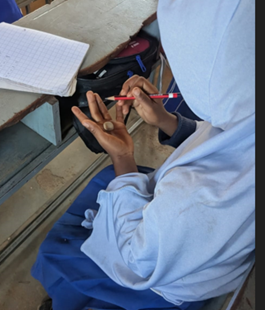
One child counts on their fingers, slowly and deliberately. The other responds immediately, without hesitation.
While both responses are accurate, they reflect very different levels of mathematical understanding.
Traditional numeracy assessments that focus solely on correct answers risk obscuring the processes learners use to arrive at those answers. As a result, they offer limited guidance for instructional improvement.
Designing the assessment toolkit
To address this, we developed a purpose-built assessment toolkit, aligned with Tanzania’s curriculum and the (CENOs) framework. The CENOS framework, developed under the NRD initiative, provides a structured progression of fluency and problem-solving competencies. It offers a valuable reference point for designing assessments that are developmentally appropriate, curriculum-aligned, and capable of generating insights that inform teaching practice.
The criterion-referenced assessment examines not only what children know, but how they arrive at the answer. By capturing learners’ strategies, these assessments offer a more nuanced and actionable understanding of foundational numeracy development. The design of the toolkit and the study methodology were developed in close consultation with Professor Mike Askew, whose expertise in early numeracy and assessment was instrumental in shaping our approach.
We designed assessments for Pre-Primary, Grade 1, and Grade 2, based on the competency-based learning continuum in Tanzania’s curriculum. Each assessment comprised ten items distributed equally across the following three types:
- Fluency – quick, foundational number tasks (10 add 3)
- Word Problems – testing application in real-life contexts (10 sweets, get 3 more sweets)
- Bald Calculations –written problems using mathematical symbols (10+3 = )
When the same maths looks different
This structure allowed us to assess the same mathematical concept in multiple formats.
For example:
- A direct calculation: 10 + 3 = ?
- A word problem: “Ali has 10 sweets and gets 3 more…”
We also varied the structure of problems:
- Result unknown: 7 − 3 = ?
- Change unknown: “Ali had 7 sweets, gave some away, and now has 4…”
This helped us understand whether children could transfer their knowledge across contexts and levels of difficulty.
Looking at methods and models
We also paid close attention to how children solved problems. Assessors recorded:
- problem-solving methods (e.g. counting on, counting all, counting back, recall)
- models used (e.g. fingers, tally marks, mental recall)
This focus on ’methods and models’ was inspired by early classroom observations, which revealed a heavy reliance on counting all, even for simple tasks that depend on a solid foundation of number sense, and efficient strategies like subitizing, number bonds of 5 and 10, or knowledge of doubles and halves.
What the data revealed
The assessment data revealed important findings.
While many children could produce correct answers on fluency tasks, performance declined significantly on items requiring pattern recognition, comparison, or multi-step reasoning.
For example, in pre-primary:
- 64% answered “add 3 and 2” correctly
- 19% solved “3 + ? = 5”
- 13% solved the same problem as a word problem
Similarly, in Grade 1:
- 57% answered “10 + 10 = ?”
- Only 34% solved a related word problem
These results suggest that many children can perform calculations, but struggle to apply their understanding in different contexts.
The data also revealed gaps in foundational number understanding.
In Grade 1:
- Over 75% of learners could identify the next number after 13
- Only 12% could extend a pattern such as 2, 4, 6…
In Grade 2, many children continued to rely on unit counting, suggesting limited understanding of number relationships. These findings underscored the importance of assessing not only what children know, but how they arrive at their answers.
Shifting the conversation
These findings allowed us to move beyond discussions of average scores.
Instead, we began asking:
How can we improve teaching and learning so that all children develop the intended mathematical competencies?
This shift from outcomes to understanding is critical for improving learning at scale. We began to look for evidence-based strategies to maximise opportunities for mathematics learning across the curriculum, to build equity of learning despite the large class sizes (Kondoa averages 90:1 pupil to teacher ratio at the Pre-Primary level) and low resource availability.
From data to programme design
The findings are already shaping our programme design.
For example:
1. We are integrating daily fluency-building routines into a new teacher handbook.
2. We are introducing visual representations like ten-frames and number lines to strengthen conceptual understanding.
3. We are using assessment data to prioritise key areas of support
The data is helping guide decisions in this important development phase.
Working in Partnership
From the outset, this work has been collaborative. We are working hand-in-hand with government partners, teachers, and curriculum developers. We are co-developing the new teacher handbook for numeracy, in partnership with the Tanzania Institute for Education, alongside teachers’ college faculty and representatives from the Ministry of Education. This approach has ensured that the findings are not just understood but owned by those who will act on them. The assessment tools, and the study findings have allowed us to involve government partners in a data-led conversation from day zero. This shared understanding is now enabling us to co-create materials for teachers and learners, grounded in the realities of Tanzanian classrooms.
Looking Ahead
This journey has reaffirmed our core belief that improving early numeracy isn’t just about test scores, it’s about better conversations. When we anchor our work in evidence and stories from real classrooms, we create the conditions for meaningful dialogue and lasting change.
If you are interested in designing your own assessment toolkit, ours is available upon request. It includes test instruments, observation templates, and guidance notes to help you get started.
Bio
KanuPriya Jhunjhunwala is Head of Education & MEL at Children in Crossfire. She has worked in international education for more than two decades, with specific expertise on early years education. Her work focuses on evidence-based transition of government policy to practice in low resource contexts, at scale. She believes in the power of equity in, and through education.
Views expressed are the author’s own